
When Quantum Machine Learning Fails Before the Quantum Circuit Even Starts
Quantum machine learning (QML) research often emphasizes quantum circuit design, entanglement, and the scaling of available qubits. However, an important challenge appears much earlier in the pipeline. Before a quantum model can be trained, classical data must first be transformed into a representation that fits on a relatively small quantum register. With quantum hardware still in an early stage, this compression step can strongly influence the performance of the entire learning process. Information lost during encoding cannot be recovered by the downstream quantum model.
Our recent work on Discretization-Aware Fine-Tuning (DAFT)1 explores this exact problem using chemical foundation models and molecular classification tasks. The study highlights that the quality of the classical representation before quantization has a direct impact on downstream quantum learning performance.
Information Compression and the Collision Problem
Chemical foundation models such as ChemBERTa generate highly expressive continuous embeddings for molecules. In the study, every molecule is represented by a 384-dimensional embedding obtained from a pretrained transformer model. Although these embeddings contain rich chemical information, they are too large to be directly encoded on today’s quantum processors. They therefore need to be compressed into short binary strings that can be encoded using only a few qubits.
The encoding strategy used in this work is bit-bit encoding, where continuous features are discretized into binary patterns and loaded into computational basis states. This approach is particularly attractive for near-term hardware because preparing computational basis states requires only a simple layer of X gates. However, the aggressive compression required for small quantum devices introduces an important limitation. Molecules with differing classification may be mapped to exactly the same binary representation, creating what are known as collisions. When colliding samples belong to different classes, the information required to distinguish them has already been lost before either a classical or quantum classifier is applied.
The paper reports that frozen ChemBERTa embeddings compressed into 3-bit representations generated more than 11,500 collision pairs on the BBBP molecular classification benchmark. These results show that a major bottleneck can arise during the encoding stage, before the quantum model is even applied.
Discretization-Aware Fine-Tuning
Traditional fine-tuning improves classification performance by making classes more separable in the continuous embedding space. However, better separation before quantization does not necessarily translate into fewer collisions after discretization. DAFT addresses this mismatch by explicitly optimizing embeddings so that they remain informative even after being compressed into discrete quantum-compatible representations.
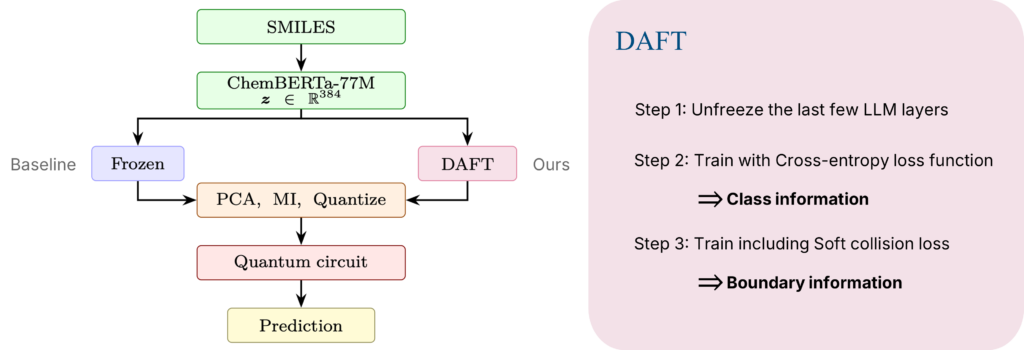
The method consists of two stages, as illustrated in Figure 1. The first stage performs conventional supervised fine-tuning using binary cross-entropy loss. The second stage introduces a differentiable soft-collision loss designed to reduce collisions after discretization. Since the true collision count cannot be optimized directly, the method estimates collision probabilities through probabilistic bin assignments, allowing gradients to propagate through the discretization process. By minimizing the probability that samples from opposite classes occupy the same quantization bin, the embedding geometry is adjusted to preserve more discriminative information after encoding.
Overview of the DAFT workflow. A pretrained chemical foundation model generates molecular embeddings, which are fine-tuned using standard classification loss followed by a discretization-aware objective that reduces collisions after binary encoding.
Why It Matters for Quantum Machine Learning
The results show that reducing collisions has a much larger impact on the quantum model than on the corresponding classical baseline. Using frozen embeddings, a classical logistic regression model outperformed the quantum model by roughly six percentage points. After applying DAFT, the quantum model improved by more than twelve percentage points, whereas the classical baseline improved by only about three percentage points. The result was sufficient for the quantum model to outperform the matched classical baseline using a 10-qubit representation.
This behaviour is intuitive when considering the models themselves. Logistic regression can only learn linear relationships between discrete bit strings. A quantum circuit, on the other hand, can exploit entangling operations to model higher-order feature interactions. Cleaner encoded representations therefore allow the quantum model to make better use of its expressive capacity. DAFT does not itself create quantum advantage; instead, it removes a significant obstacle that previously prevented the quantum model from exploiting the information available in the encoded data.
Importance of Representation Design in Quantum Machine Learning
These results emphasize the role of data representation in near-term quantum machine learning pipelines. The performance of the model depends not only on the quantum circuit architecture, but also on how classical data is compressed and encoded into a limited number of qubits.
A key challenge is the mismatch between high-dimensional continuous representations produced by classical models and the discrete representations required for quantum encoding. DAFT addresses this challenge by adapting the embedding space before discretization, reducing information loss during the encoding process.
The results demonstrate that improving the compatibility between classical representations and quantum encoding can significantly affect downstream model performance. This suggests that designing effective quantum machine learning systems requires careful consideration of both the quantum model and the classical-to-quantum data representation pipeline.
The Red Cedar quantum machine learning platform from Cascade Quantum is designed to explore these questions by enabling systematic analysis of classical-to-quantum data representations and quantum machine learning models. If you are working with complex datasets or applications that require deeper investigation, get in touch with Cascade Quantum to explore how quantum AI methods can be applied to your problem.
We would love to hear about the types of datasets and applications you are exploring. Get in touch with us through our contact form.
Special thanks to Shunji Matsuura for technical contributions.
References
- Shunji Matsuura and Sonika Johri, “Discretization-Aware Fine-Tuning for Quantum Machine Learning with Chemical Foundation Models” 2026. Available: https://arxiv.org/abs/2609.03220 ↩︎