
Machine learning has emerged as a powerful tool for analyzing complex datasets across diverse fields. By learning patterns directly from data, machine learning can uncover relationships and make predictions that are difficult to capture using traditional statistical approaches.
Advances in data collection and storage have made it possible to construct rich datasets across many domains. Modern datasets are larger and more complex than ever, often involving thousands of interacting variables. These variables, called features, describe the data, while each data point (or sample) represents one observation. As the number of features grows, extracting insights using conventional machine learning methods alone becomes increasingly challenging, motivating interest in quantum machine learning (QML).
In this setting, an important consideration for how well a model performs is how the dataset itself is represented. With QML, classical data must first be encoded into quantum states before it can be processed. The choice of representation plays a central role because it determines how efficiently the data can be mapped onto qubits and what information is available to the model. As a result, the quality of the representation directly impacts the performance and scalability of quantum learning approaches. This naturally leads to a central question:
Given a dataset and a learning task, can quantum computers offer an advantage over classical approaches, and if so, how many qubits are needed to realize it?
Answering this question is difficult. Empirical demonstrations of quantum advantage in machine learning remain limited, and classical and quantum models often achieve similar performance on common benchmark datasets. As a result, it remains unclear when quantum approaches may provide meaningful benefits.
The Quantum Resource Estimator (QRE) tool from Cascade Quantum is designed to address this challenge. Instead of comparing the performance of specific models, QRE analyzes the intrinsic structure of a dataset and estimates how many qubits are required to represent it. If a dataset can be represented using only a small number of qubits, it is likely to remain tractable for classical computation, and quantum hardware may not offer a significant advantage. In contrast, datasets requiring larger quantum representations may correspond to regimes where quantum machine learning could provide meaningful benefits. Because this analysis can be performed before training models or investing in specialized hardware, QRE enables researchers to assess the potential utility of quantum approaches at an early stage, thereby saving substantial computational effort, development time, and experimental cost.
The QRE framework builds on bit–bit encoding, a data encoding method introduced in Cascade Quantum’s Red Cedar quantum machine learning platform1. In bit–bit encoding, real-valued feature vectors are converted into compact binary representations (bitstrings) that can be mapped directly onto qubits. Figure 1 illustrates the overall pipeline used by QRE: the dataset is preprocessed, transformed into feature representations, and then discretized into binary values using bit–bit encoding.
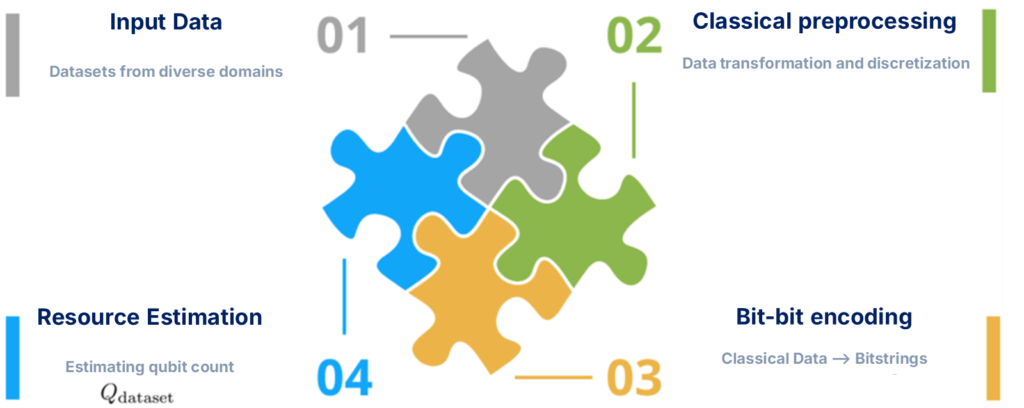
| Automated Quantum Resource Estimation Users simply upload their dataset. QRE does the heavy lifting by handling preprocessing, feature transformation, bit–bit encoding, collision analysis, and quantum resource estimation. The framework then generates accuracy-versus-qubit scaling curves, enabling users to assess the suitability of quantum machine learning approaches without requiring expertise in quantum computing or quantum hardware. |
When the dataset is encoded using only a small number of bits, different samples may map to the same binary representation. If those samples correspond to different class labels, the encoded dataset contains conflicting information. These are called collisions, meaning that identical input bitstrings correspond to multiple outputs.
QRE resolves this by gradually increasing the number of bits used in the encoding, making the representation more expressive and reducing collisions between samples. As more bits are added, the encoding becomes detailed enough to distinguish all samples.
The minimum number of bits required to eliminate these collisions determines the number of qubits needed to faithfully represent the dataset in a quantum model. We denote this quantity as Qdataset(x) 2, which captures the number of qubits required to model a dataset to an accuracy ‘x’. In particular, Qdataset(1.0) corresponds to the number of qubits required to achieve perfect (100%) training and testing accuracy.
The value of Qdataset(1.0) reflects how complex the dataset is to represent. Higher values indicate that more expressive representations are needed, which may motivate the use of quantum machine learning approaches. In practice, classical simulation of quantum systems becomes computationally challenging beyond roughly 50 qubits3 due to the exponential growth of the quantum state space. Therefore, if a dataset encoding requires models operating at scales larger than this threshold, it may indicate regimes where quantum machine learning approaches could potentially offer an advantage.
In this post, we present a series of supervised learning case studies to illustrate the application of QRE across diverse domains.
We begin with a simple example: tabular biomedical data.
Use Case 1: Cancer Classification
A commonly studied example is the Wisconsin Diagnostic Breast Cancer (WDBC) dataset, which consists of structured features extracted from medical measurements. The task is to classify tumors as benign or malignant based on these features.
Such datasets are relatively compact and serve as a useful baseline for understanding how QRE behaves on simpler problems.
QRE Insights
Using QRE, we analyze how classification performance scales with the number of qubits.
Figure 2 illustrates the end-to-end QRE pipeline for the WDBC dataset, from feature preprocessing and bit–bit encoding to quantum classification and resource estimation. The final panel shows how classification accuracy varies with the number of qubits used to represent the data.
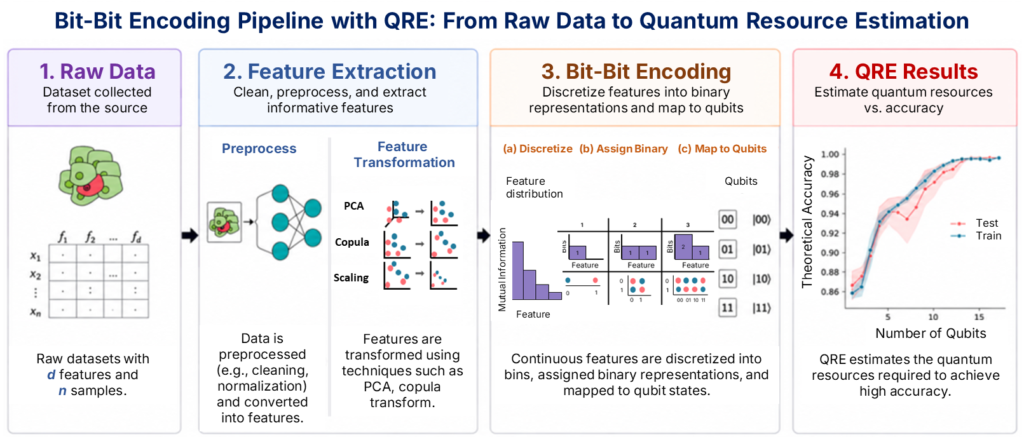
As the number of qubits increases, the representation becomes more expressive, leading to improved classification performance. However, the curve saturates relatively quickly, indicating that only a modest number of qubits is sufficient to capture the dataset effectively. In particular, QRE estimates Qdataset(1.0)≈16 for this representation, indicating that collision-free encoding of the dataset can be achieved with relatively few qubits.
This suggests that the dataset is relatively simple from a representation perspective, with limited ambiguity between compressed samples.
This example highlights that not all datasets demand large quantum systems. For structured tabular data like WDBC, QRE predicts that accurate representations can be achieved with relatively few qubits, making such datasets less suitable for demonstrating quantum advantage—but useful for validating quantum learning pipelines. A more detailed analysis of this use case can be found in Ref. [3].
We now move to a more complex setting involving neuroscience data.
Use Case 2: Neuroscience for Epilepsy Analysis
In this use case, we explore how QRE can be applied to electroencephalography (EEG) data for tasks such as seizure localization and surgical outcome prediction. Brain signals contain complex temporal patterns across multiple electrode channels, making them challenging to process using conventional machine learning methods.
Dataset and Preprocessing
We use a publicly available EEG dataset for binary seizure classification (seizure vs non-seizure). Each sample consists of multichannel EEG recordings that capture the electrical activity of the brain over time under normal and seizure conditions. The normal (non-seizure) brain signals serve as the reference class, while seizure recordings represent abnormal neural activity, enabling the model to learn discriminative patterns between the two classes. To understand how dataset structure affects quantum resource requirements, we analyze the following aspects of the data:
Feature representation:
- Raw time series signals (temporal domain)
- Frequency-domain features obtained using Fast Fourier Transform (FFT)
Class distribution:
- Original unbalanced dataset
- Balanced version
This allows us to compare how both representation and dataset structure influence QRE predictions.
QRE Insights
The extracted EEG features are passed into the QRE pipeline using bit–bit encoding, which maps real-valued feature vectors into compact binary representations on qubits. The resulting QRE curves show how classification performance scales with the number of qubits across different dataset settings (Figure 3).
Effect of Class Imbalance
In the unbalanced time series case (Fig. 3(a)), accuracy improves slowly at first, with training accuracy remaining near ~80% before increasing sharply. Since the dataset contains an approximately 80:20 majority-to-minority class ratio, the initial plateau near 80% is because at low qubit counts the encoding effectively assigns all samples to the majority class. In this regime, the model behaves similarly to a trivial classifier that “memorizes” dominant-class statistics rather than learning meaningful discriminative seizure features. QRE estimates Qdataset(1.0) ≈ 29 for this representation, and there is a noticeable gap between training and test performance at lower qubit counts.
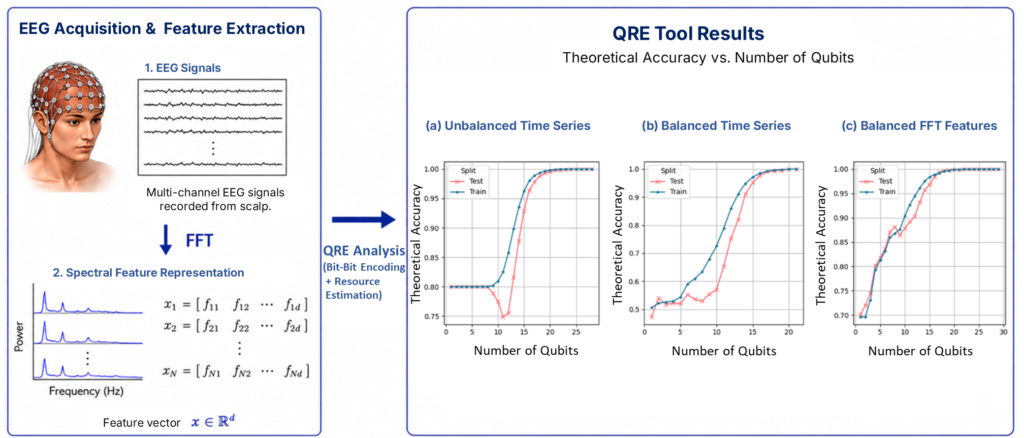
predicts the required quantum resources.
In contrast, for the balanced time series dataset (Fig. 3(b)), training and test accuracy increase more smoothly and converge earlier. QRE estimates Qdataset(1.0) ≈ 22, indicating a more efficient use of representational capacity. This suggests that balancing the dataset allows the quantum encoding to allocate its representational capacity toward genuine discriminative seizure features rather than compensating for distributional bias. Together, these results suggest that class imbalance should be addressed to make optimal use of quantum resources.
Effect of Feature Representation (Time Series vs FFT)
We next compare the QRE accuracy–qubit scaling curves for the balanced time series and balanced FFT representations shown in Fig. 3(b) and Fig. 3(c), respectively. While the balanced time series representation reaches Qdataset(1.0) ≈ 22, the FFT-based representation requires Qdataset(1.0) ≈ 30. However, the key observation is that the FFT representation exhibits a significantly smaller gap between training and test accuracy, indicating closer agreement between training and testing performance. This suggests that applying FFT to the EEG signals produces encodings that generalize more effectively across unseen samples.
Although FFT features capture richer spectral information, they also increase the effective complexity of the dataset. As a result, more qubits are needed to encode and utilize these features within the quantum model. The higher qubit requirement demonstrates a trade-off between feature richness and quantum resource cost.
Taken together, these results show that dataset structure plays a key role in determining quantum resource requirements. Class imbalance can bias the encoding toward the majority class, while feature representation influences how well the model generalizes. QRE captures both effects directly through accuracy–qubit scaling, providing a practical way to understand how preprocessing choices influence quantum resource demands.
Next, we consider language data, where high-dimensional embeddings are used.
Use Case 3: Language Model Classification
In language data, text is represented using embeddings from pre-trained language models. These embeddings capture semantic information and are widely used for tasks such as sentiment analysis, topic classification, and recommendation systems.
While powerful, adapting these models to specific tasks often requires extensive fine-tuning and computational effort. In this use case, we explore whether quantum models can operate directly on pre-trained embeddings, without additional training.
Dataset
We consider a binary sentiment classification task using the SST-2 dataset, where sentences are converted into embeddings using a pre-trained model such as BERT or SetFit. These embeddings serve as input features for the quantum classifier.
Figure 4 shows how classification performance varies with the number of qubits.
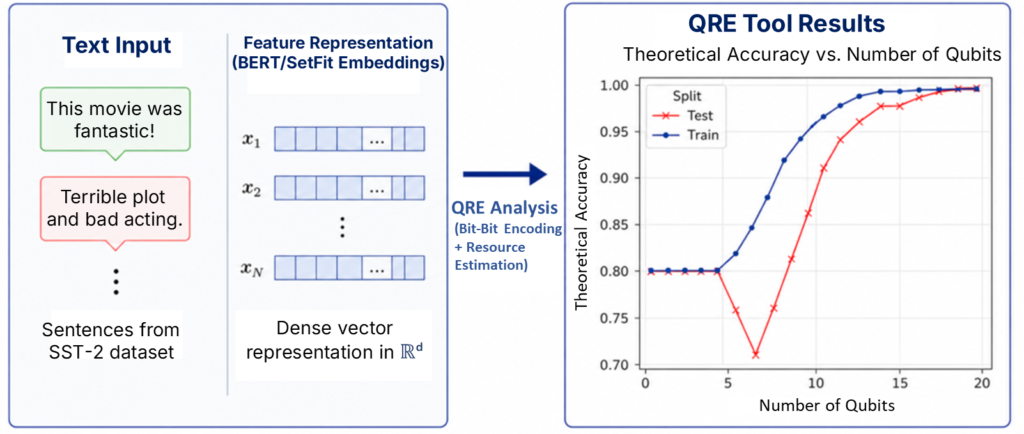
Estimated Quantum Resources
As the number of qubits increases, performance improves, reflecting a more expressive representation of the embedding space. The dip following a plateau at low numbers of qubits arises from the class imbalance in the selected SST-2 subset. Nevertheless, the performance curve saturates relatively early, as seen in the previous use cases. QRE estimates Qdataset(1.0) ≈ 18 for this task, indicating that only a modest number of qubits is required to capture the dataset effectively.
This suggests that, despite the high dimensionality of language embeddings, the effective complexity of benchmark tasks such as SST-2 remains limited from a quantum resource perspective. Pre-trained embeddings can therefore be represented efficiently using relatively few qubits, making them accessible for near-term quantum models.
At the same time, more challenging tasks, such as multi-class classification, longer text sequences, or context-dependent reasoning, may be needed to fully explore potential quantum advantages.
We next consider a molecular dataset, where capturing the underlying structure requires more expressive representations.
Use Case 4: Molecular Property Prediction
Predicting molecular properties is a central challenge in computational chemistry, with applications ranging from materials discovery to drug design. These properties are often computed using expensive quantum chemistry simulations, making efficient prediction methods highly valuable.
Datasets
We consider datasets derived from the QM9 benchmark, which contains thousands of small organic molecules along with quantum chemically computed properties. Each molecule is represented by numerical features derived from its atomic structure, and the task is to predict continuous properties such as energy or dipole moment.
Unlike the previous examples, this task is formulated as a regression problem. To apply QRE, the continuous target variable is discretized into bins and represented using a fixed number of output qubits, allowing the problem to be treated as a classification task for the purpose of analysis.
Estimated Quantum Resources
Figure 5 shows the QRE analysis for molecular property prediction datasets, with the final panel illustrating the prediction accuracy–qubit scaling for this task.
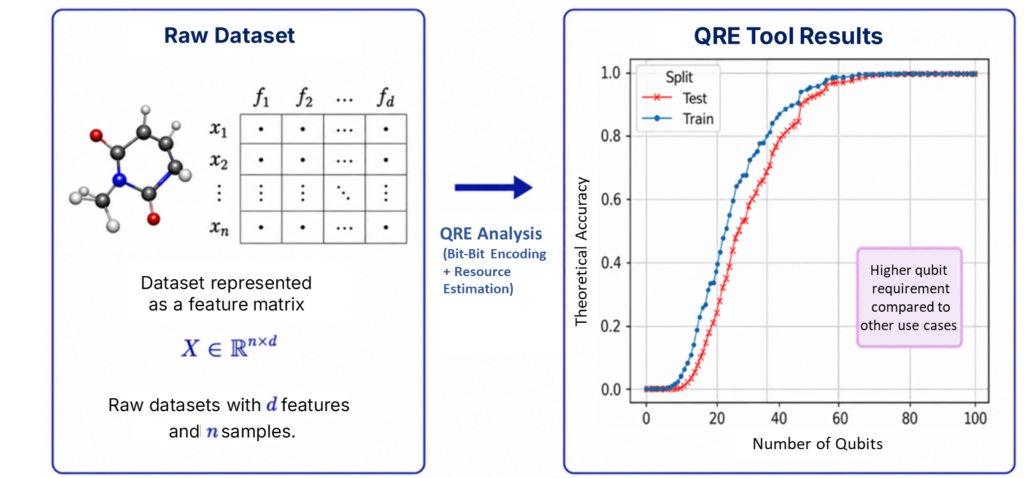
Compared to earlier examples, the curve extends toward higher qubit values, indicating that more expressive representations are required. This reflects the properties of the dataset used here, which is larger and retains more detailed structural information than earlier examples, leading to higher representational requirements. As a result, this dataset may provide a useful setting for exploring quantum machine learning approaches.
Across these examples, QRE highlights that the quantum resources required are driven not just by the dimensionality of the data, but by its underlying structure. Datasets that can be represented with relatively few qubits tend to have simpler or more redundant structure, while others require more expressive representations. QRE therefore serves as a critical first step in a quantum machine learning project, helping assess whether a dataset warrants the use of quantum resources before developing quantum models or algorithms.
Importantly, these observations are dataset specific. Differences in size, preprocessing, and feature representation can significantly impact the estimated resource requirements, and direct comparisons across datasets should be interpreted with care.
Beyond the examples explored here, QRE can be applied to a wide range of domains with complex, high-dimensional data. Potential areas of interest include genomics, condensed matter physics, materials science, and climate modeling, where large numbers of interacting variables give rise to rich structure. Exploring such domains will help identify settings where more expressive representations are required, and where quantum machine learning approaches could offer new insights.
A key advantage of QRE is that the entire analysis is automated. Users only need to provide a dataset, while the framework performs the underlying bit–bit encoding, collision analysis, and quantum resource estimation needed to assess the suitability of quantum machine learning approaches.
To explore these ideas further, you can try the QRE web tool by uploading your own dataset and obtaining an estimate of the quantum resources required. Experimenting with different preprocessing choices can provide additional insight into how dataset structure influences representation.
QRE serves as a first step in understanding whether quantum machine learning may be relevant for your problem. For more complex datasets that require deeper analysis or custom preprocessing, or to get early access to the full Red Cedar quantum AI framework, get in touch with Cascade Quantum.
We would love to hear about your experience and the types of datasets you explore. Get in touch with us through our contact form.
Special thanks to Sydney Leither, Shunji Matsuura, and Davin Hickman-Chow for technical contributions.
References:
- S. Johri, “Bit-bit encoding, optimizer-free training and sub-net initialization: techniques for scalable quantum machine learning” 2025. Available: https://arxiv.org/abs/2501.02148 ↩︎
- S. Leither, M. Kubal, and S. Johri, “How many qubits does a machine learning problem require?” 2025. Available: https://arxiv.org/abs/2508.20992 ↩︎
- S. Leither, T. Lubinski, M. Kubal, and S. Johri, “Benchmarking Quantum and Classical Machine Learning Models on Oncological Data” 2026. Available https://arxiv.org/abs/2608.11373 ↩︎